JD.COM released the 618 consumption forecast report when he got home.
BEIJING, June 13 (Xinhua)-Today, JD.COM released the "Report on the Prediction of Instant Retail Consumption Trend of JD.COM Home 618" (hereinafter referred to as the report), and predicted the consumption trend on the day of 618 through a comprehensive analysis of the consumption big data of 91 cities across the country. According to big data analysis, the blowout and single-point explosion of orders on the day of 618 in previous years will be transformed into high-growth and sustainable transaction volume, and the on-demand purchase and multi-segment peak will become the norm, and the all-day peak is expected to appear at 10 am.
Instant consumer demand has expanded from daily necessities and food to all categories, and many explosive products will be born in the market segments such as beauty care, nutrition and health care, maternal and child, and home. Big data confirms that "fruit freedom" needs no anxiety, litchi will become the best-selling fruit on the day of 618, and domestic cherries will attack apples and cherries. The "other economy" has risen strongly, and the boys after 90 are most willing to "chop their hands" for the United States. With the rapid sinking of instant consumption, nearly half of the low-tier cities in 618 are expected to double their sales on the same day.

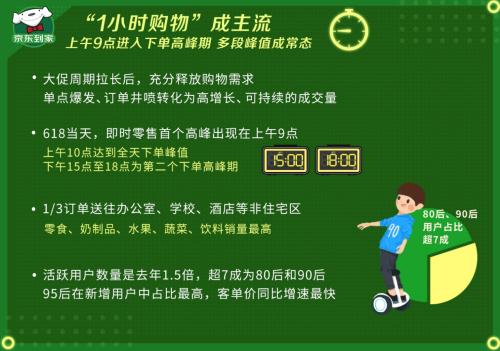
"One-hour shopping" became the mainstream and entered the peak order period at 9 am.
The report shows that with the extension of this year’s promotion cycle, the shopping demand has been fully released. In previous years, the blowout and single-point explosion of orders on the day of 618 will be transformed into high-growth and sustainable transaction volume, and multiple peaks will become the norm. Under the tide of "one-hour shopping", the first peak of 618 instant consumption will appear at 9: 00 am and reach the peak of all-day orders at 10: 00 am; From 15: 00 pm to 18: 00 pm, it is the second peak period for placing orders. About one third of orders are sent to offices, schools, hotels and other non-residential areas. Snacks, dairy products, fruits, vegetables and drinks will be the most popular categories.
Over 70% of consumers are post-80 s and post-90 s, and post-95 s accounts for the highest proportion of new users, with the fastest growth rate of customer unit price. Instant consumption demand has expanded from daily necessities and food to all categories, and personal care, beauty cosmetics, nutrition and health care, maternal and child care and household items will be the categories with the highest sales growth. These market segments, which represent consumption upgrading, will give birth to many "explosive products" such as fruit cutting, dental floss sticks, mouthwash, mini-fans, aromatherapy, throat candy, vitamin tablets, diapers, baby wipes and so on.
Litchi guards "fruit freedom". Domestic cherries attack cherries.
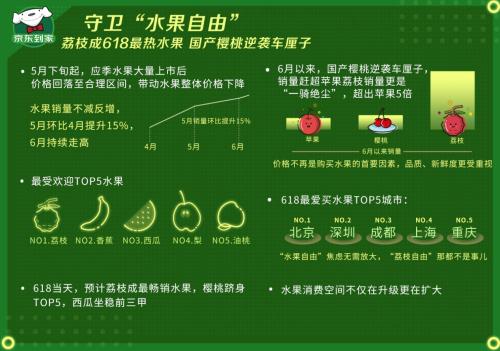
Recently, due to the rising prices of "national fruits" such as apples and pears, many netizens teased themselves not to mention "freedom of cherries" and "freedom of litchi", and even "freedom of apples" could not be achieved. Is "fruit freedom" really hard to achieve? JD.COM’s home report shows that this "618", "Litchi Freedom" and "Cherry Freedom" are nothing. Since the end of May, after a large number of seasonal fruits such as watermelon, litchi, domestic cherry, bayberry and nectarine have been listed, the price has dropped from the high level just listed to a reasonable range, driving the overall price of fruits down. On the eve of June 18, the average selling price of fruits dropped by 5 percentage points compared with the end of May. In the past two months, the overall sales volume of fruits has increased instead of falling. The sales volume in May increased by 15% compared with that in April, and continued to rise in June.
In terms of sales volume, litchi, banana, watermelon, pear and nectarine are the most popular TOP5 fruits since May, followed by apples and domestic cherries. After June, the sales of domestic cherries began to catch up with apples; The sales volume of litchi is even worse, which is five times higher than that of apple. It is expected that on the day of June 18, litchi will continue to "occupy" the top spot of fruit sales, watermelon will sit firmly in the top three, and cherry will squeeze into the TOP5 list. Beijing, Shenzhen, Chengdu, Shanghai and Chongqing will be the TOP5 cities that love to buy fruits on June 18th.
In this regard, JD.COM’s home data analyst believes that on the one hand, fruit consumption is just needed; On the other hand, there are many varieties of fruits to choose from, and the prices of some categories have risen in the short term. However, with the sufficient supply of fruits in season, the consumption of fruits has not been substantially affected, and the public’s anxiety about "fruit freedom" is more at the spit level. Since June, the sales of litchi and domestic cherry have been higher than that of apple. Consumption data prove that price is no longer the first choice for people to buy fruit, and quality and freshness are more valued by consumers. The consumption space in the fruit market is not only upgrading, but also expanding.
Post-90s men wear "He Economy" mask to become the hottest men’s skin care products.
Although 618 women’s spending still accounts for more than half of the country’s total, in the market segments dominated by traditional female consumers such as personal care, beauty cosmetics and health care products, the "other economy", which has long been neglected, is rapidly rising and becoming a new growth point. During the 618 promotion period, the number of male users searching for keywords such as "mask", "moisturizing", "sunscreen" and "anti-wrinkle" surged three times compared with the same period last year. JD.COM predicted that on the day of June 18th, the sales growth rate of male skin care products, the sales growth rate of male purchase of beauty health care products and beauty products is expected to exceed that of female. After 90, male consumers are most willing to "pick their hands" for beauty, and the consumption proportion among male groups will reach 60%.
Quest Mobile data shows that the number of monthly mobile Internet activities for men in China has reached 590 million. The improvement of male netizens’ economic strength, the awakening of self-awareness and the change of the concept of consumption upgrading have promoted the rapid development of "other economy" and penetrated into skin care, beauty cosmetics, fashion and other sub-fields. In the past year, the sales of personal beauty products specially made for men have soared, and the proportion of men placing orders for masks, eyebrow pencils, sunscreens, BB creams and beauty and anti-aging health products has also increased rapidly. Mask, lotion, cleanser, men’s perfume and lipstick are expected to be the top-selling men’s skin care and beauty products of TOP5 in 618 this year.
During the 618 period, TOP5, the city where the most beautiful men gathered, was Shanghai, Beijing, Chengdu, Guangzhou and Shenzhen. Among them, Shanghai men pay the most attention to facial skin care, Chengdu men have the strongest consumption power to buy beauty products such as lipstick, eyebrow pencil and BB cream, Guangzhou men pay the most attention to summer sun protection, and Beijing men care about oral care. The exquisite boys who pursue "style and face" are strongly assisted by their female companions, and nearly one third of men’s skin care products are purchased by women.
"One-hour shopping" sinks rapidly. Sales in nearly half of low-tier cities are expected to double year-on-year
Although the first-and second-tier cities are still the main battlefields of instant consumption in 618, with the rapid sinking of "one-hour shopping" consumption mode, the instant consumption potential of low-tier cities has been released, and both the number of users and the amount of consumption have shown a high growth trend. In view of the young people in small towns who dare to spend money and have leisure to play, during the period of June 18th this year, JD.COM came home and tried some social and gamification games, such as helping friends to grab coupons, fighting for free tickets, and exploding low-priced groups. The effect was outstanding, and half of the new users brought by fission marketing came from third-tier and below cities. At present, there are 91 cities in JD.COM, including more than 50 third-tier and below cities. Nearly half of the third-and fourth-tier cities expect 618 sales to double year-on-year. The representative cities are Putian in Fujian, Zhanjiang in Guangdong, Mianyang in Sichuan, Laixi in Shandong, Yueqing in Zhejiang, Maanshan in Anhui and Langfang in Hebei.
Compared with consumers in first-and second-tier cities, users in third-tier cities and below are younger, and more than 70% are post-85 s and post-90 s groups. Young people in small towns are willing to adopt early adopters, pay attention to cost performance, and show strong demand for quality consumption and fashionable lifestyle. This year, in the consumer goods category, they bought the most food and daily necessities; Brand selection prefers domestic brands, and store selection prefers "one-stop purchase" from chain stores. Drinks and beverages, medical care, personal care and beauty cosmetics, imported fruits and other consumption upgrading categories representing quality and personality have the fastest growth rate in the sinking market.